
Some kidney preservation runs end within a few hours, while others stretch into the next day. Many centers are transplanting kidneys with a mean total ex-situ time exceeding 20 hours, from cross-clamp to the end of perfusion before transplantation. That interval includes preservation before pumping and time on hypothermic machine perfusion (HMP). For organ recovery teams, these extended timelines bring shift changes, transport coordination, and more opportunities for information to slip.
As donor kidneys and recipients travel greater distances to transplant centers, preservation and scheduling become increasingly interconnected. Advances in perfusion and temperature-controlled transport are expanding the options available to teams managing longer preservation intervals. Those capabilities make disciplined handoffs, complete documentation, and reliable coverage essential throughout the kidney’s journey.
The Hidden Toll of Extended Pump Runs on Organ Recovery Teams
A kidney’s preservation timeline can extend beyond the staffing window originally planned for the case. Allocation changes, recipient preparation, transportation, and operating room availability may all affect when perfusion ends. Programs therefore need coverage that can adapt when a short assignment becomes an overnight or next-day responsibility.
Longer preservation also deserves a balanced clinical interpretation. A 2026 study in the American Journal of Transplantation examined 137,835 kidney transplant recipients and found that HMP was associated with reduced delayed graft function and mitigation of the adverse effects of increasing cold-preservation time. These observational findings support HMP’s role during extended preservation, while leaving individual acceptance decisions with the transplant team.
For the staff managing the kidney, the challenge is maintaining attention across the entire assignment. Pump monitoring may compete with allocation calls, recovery responsibilities, and other clinical duties. A coverage plan should identify the primary specialist, the relief team, and the backup contact before fatigue or competing demands create a gap.
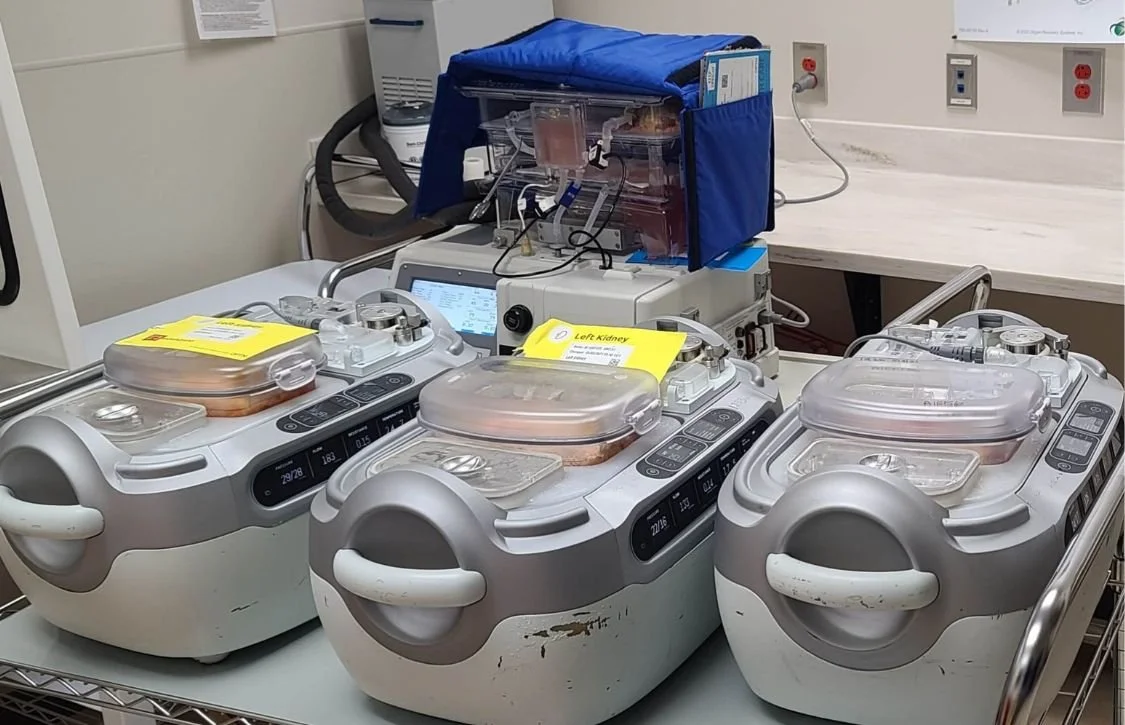
GSP has explored workforce burnout in critical transplant jobs. Long-duration coverage should address that operational pressure directly by giving staff a clear route to request relief and transfer responsibility.
Clean Handoffs During Long-Duration Organ Recovery
A stable pump screen does not communicate everything the next specialist needs to know. Earlier cannulation concerns, pressure adjustments, temperature changes, and conversations with the accepting surgeon may explain the current readings. Every transition should preserve that history and identify what still needs attention.
The AHRQ TeamSTEPPS I-PASS framework provides a useful structure: summarize the situation, identify pending actions, explain contingency plans, and have the receiving clinician confirm understanding. Applying those principles to kidney preservation offers a practical approach to handoffs, although the framework was developed for patient care rather than specifically validated for HMP.
What Makes a Safe Handoff During Long-Duration Organ Recovery?
A safe handoff transfers the kidney’s preservation history, current condition, pending tasks, and escalation plan. The incoming specialist reviews the record and confirms responsibility before the outgoing specialist leaves. When an in-person exchange is impractical, the same information should be reviewed through direct communication with access to the current readings and documentation.
Each handoff should include:
• Identity and timeline: donor identifier, laterality, cross-clamp time, perfusion start time, previous preservation methods, and accumulated preservation duration.
• Current parameters and trends: pressure setting, measured pressure, flow, resistance, and temperature, including significant changes during the previous shift.
• Interventions and observations: cannulation adjustments, branch management, pressure changes, re-icing, interruptions, and relevant visual findings.
• Pending actions: the next monitoring entry, anticipated relief, cooling or battery needs, transport milestones, and unresolved questions.
• Escalation and ownership: who has been contacted, what instructions were received, who to call next, and who now holds responsibility.
The receiving specialist should restate the immediate priorities and clarify anything uncertain. Record both names and the transfer time so the clinical record shows continuity across shifts, teams, and facilities.
Documentation That Stays Audit-Ready Hour After Hour
Long-duration documentation should preserve the full timeline without forcing each new specialist to reconstruct it. Cross-clamp time, static storage, previous pumping, GSP-managed perfusion, interruptions, and the end of perfusion should remain distinguishable. A change of staff, location, or device should not reset the kidney’s preservation clock.
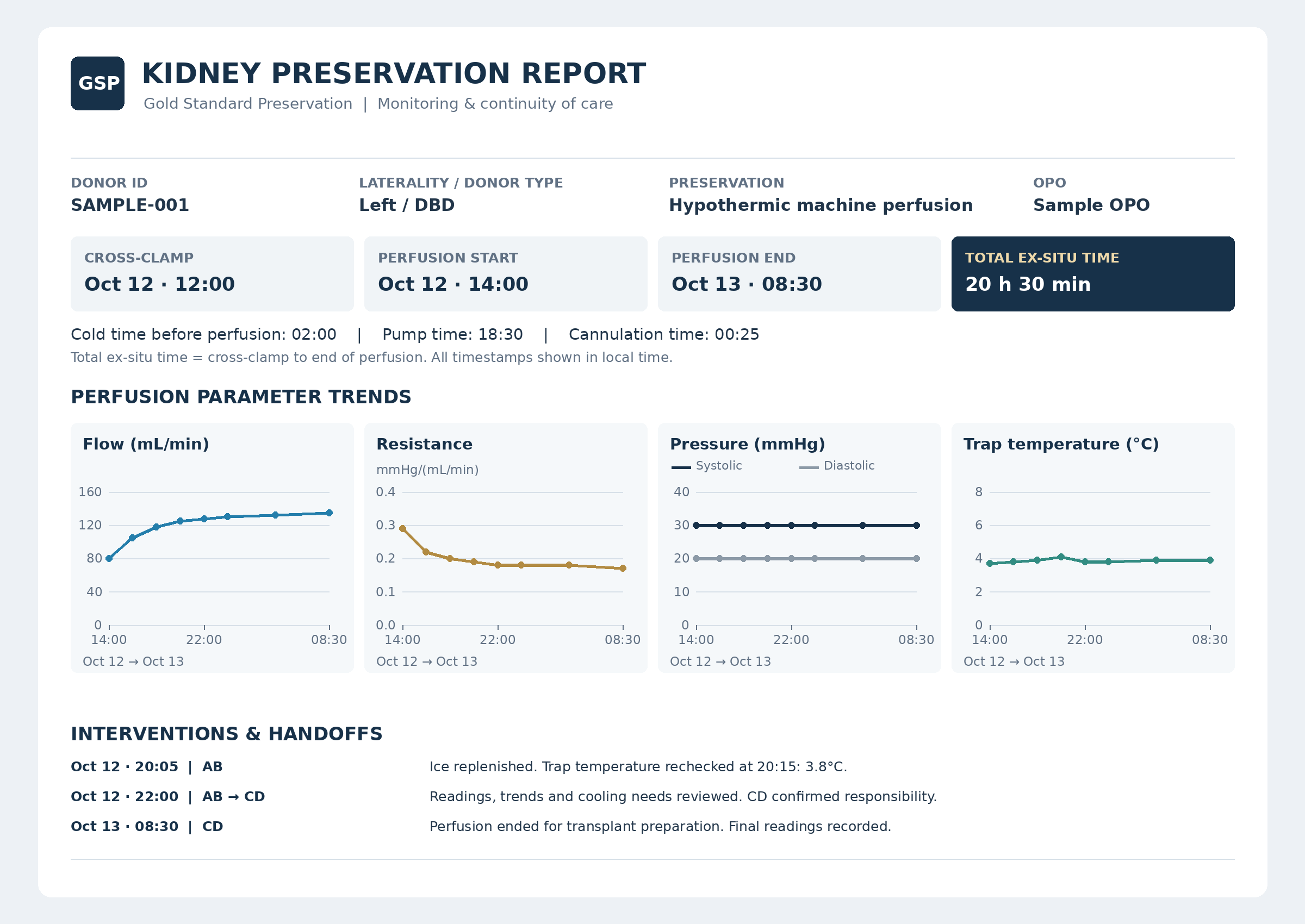
If a kidney remains in cold storage afterward while the recipient operation proceeds, that additional interval must be captured separately to describe preservation through implantation accurately.
A consistent record should include:
• Pressure, flow, resistance, and temperature at protocol-defined intervals.
• Each intervention, its reason, the person responsible, and the response observed afterward.
• Alarms, troubleshooting findings, and resolution, distinguishing confirmed causes from suspected explanations.
• Cooling replenishment, power changes, perfusion interruptions, and transitions between preservation methods.
• Transport milestones and handoffs, including pending concerns and instructions from the transplant team.
Device-generated data can strengthen the record, but programs should understand what their platform captures and how long it retains it. For example, the LifePort operator’s manual describes automatic recording during infusion and limits on file duration and case storage. Long-run protocols should account for those limits and preserve exported records according to institutional practice.
GSP’s work on reliable organ transport and recovery logistics applies the same principle: documentation should follow the kidney and remain accessible to the people responsible for its next stage of care.
Risk Management Without Overworking Hospital Teams
Risk management during a long run extends beyond watching flow and resistance. It includes maintaining temperature, anticipating consumable and power needs, arranging relief, and coordinating the next preservation or transport step. Each responsibility needs a named owner.
Temperature Control Beyond Conventional Ice Storage
Preservation is evolving toward more deliberate temperature management. Conventional ice-based storage remains widely used, while engineered cooling systems offer ways to maintain a defined temperature range more consistently. Some of these systems still provide static cold storage; others combine controlled cooling with machine perfusion.
Phase-change materials (PCM) absorb or release heat as they change phase at a selected temperature. This allows a cooling system to buffer temperature changes around its designed operating range. A published thermal study of SherpaPak systems examined this approach in organ transport. Its temperature-performance findings should be distinguished from proof of improved outcomes in transplanted kidneys.
PCM technology is also incorporated into kidney HMP. The FDA 510(k) summary for KidneyVault describes pulsatile perfusion with PCM cooling designed to maintain 4 to 8°C through 24 hours. That is a specification for the particular system, rather than a universal temperature target or an automatic extension of acceptable preservation time.
Cold-chain specialists such as MaxQ bring thermal packaging, validation, and transport expertise to this work. LifeShare’s LifeSafe collaboration with MaxQ describes an organ transport system incorporating temperature regulation, monitoring, and tracking. These capabilities help teams plan and document the transport environment across a longer journey.
For long-duration cases, the operational questions remain specific: Was the cooling system conditioned correctly? Does its validated configuration cover the anticipated journey? What temperature is being measured? Who responds if the recorded temperature moves outside the approved range?
Ice-cooled HMP platforms likewise require active management. Teams should follow the device instructions and approved re-icing procedure, reassess the temperature trend after replenishment, and communicate the next cooling and power needs during handoff. The LifePort manual specifically calls for monitoring ice and battery levels throughout preservation.
Longer Preservation Requires Clearer Boundaries
Research is also exploring warmer perfusion strategies that change how kidneys are preserved and assessed. A 2025 phase 1 study in Nature Communications evaluated prolonged normothermic kidney perfusion in 36 transplant recipients, investigating durations up to 24 hours. The study supports further development of this approach; its findings do not establish equivalent allowances for cold storage or routine HMP.
As preservation options expand, protocols should specify the method, temperature range, monitoring requirements, and transition plan for each phase. A container’s validated thermal duration and a kidney’s clinically acceptable preservation duration answer different questions.
Pressure management also needs continuity across shifts. Increasing pressure can increase flow without producing a corresponding reduction in calculated resistance. Every adjustment should follow the approved protocol and remain visible in the handoff record so the next specialist can interpret the trend accurately.
Outsourced specialists can help programs sustain this coverage when internal teams have competing responsibilities. The arrangement should define qualifications, monitoring duties, escalation authority, relief expectations, and backup coverage. Those details make extended runs manageable without relying on one person’s endurance.
Protect Your Team and Every Organ Recovery Case
GSP’s observed mean ex-situ time of more than 20 hours underscores the need to plan preservation as a continuous clinical and logistical process. Structured handoffs, complete records, temperature management, and dependable coverage help maintain that continuity from recovery through the final perfusion stage.
Improving preservation technology creates new opportunities, while careful execution remains essential throughout each case. Whether a kidney travels in a validated cold-chain container or remains on HMP across several shifts, the next team needs a clear account of its history and current needs.
Gold Standard Preservation provides around-the-clock organ perfusion support with standardized handoffs, documented interventions, and defined escalation pathways. Our specialists help transplant centers and OPO teams manage extended preservation while keeping the accepting surgeon informed. Contact our team to discuss long-duration kidney HMP coverage for your program.