
Utilizing Machine Perfusion to Optimize Kidney Placement Success
Kidney placement decisions rank among the most consequential and time-constrained choices in transplant medicine. Donor shortages, geographic variability, and unpredictable donor physiology force transplant teams to make high-stakes decisions with incomplete information. Machine organ perfusion is changing that calculus. Programs that want to improve kidney placement outcomes are making it an operational priority.
This article examines how HMP supports better placement decisions. It also covers what operational requirements HMP programs need and how clinical expertise determines whether the technology delivers.
The Kidney Placement Problem
Delayed graft function (DGF) remains a significant clinical challenge in kidney transplantation. DGF occurs when impaired initial kidney function requires dialysis in the first post-transplant week. Rates vary widely by donor type and center across the United States. DCD and extended-criteria donor (ECD) kidneys consistently show higher DGF rates. These donor categories also represent a growing share of available organs.
Peer-reviewed research shows that DCD kidneys have higher DGF rates than DBD kidneys, even when adjusting for donor quality scores. That gap makes pre-implantation viability assessment a clinically meaningful opportunity for transplant programs.
How HMP Supports Kidney Placement Decisions
Hypothermic machine perfusion (HMP) does more than preserve kidney viability during transport. It generates flow rates and vascular resistance measurements that inform organ function assessment. These data points are not definitive outcome predictors on their own. However, they correlate with organ quality and guide placement decisions at the transplant center.

Key clinical benefits associated with HMP include:
• Reduced DGF rates compared to static cold storage in multiple published studies, particularly for DCD and ECD kidneys
• Real-time perfusion parameters that give transplant teams additional data when evaluating marginal organs
• Continued organ conditioning during transport, rather than simple preservation, which may reduce ischemic injury accumulation
• Potential to extend preservation time in complex logistics situations without equivalent quality degradation
A landmark randomized trial by Moers et al., published in the New England Journal of Medicine, demonstrated that HMP correlated with a reduced risk of delayed graft function and improved graft survival compared to static cold storage in deceased-donor kidney transplantation."
Reading the Data: What HMP Parameters Actually Tell You
The value of HMP data depends almost entirely on who interprets it. Flow rates and vascular resistance measurements are not pass/fail metrics. They require clinical context to mean anything useful. Donor medical history, recovery circumstances, pump duration, and trending values all shape the interpretation.
Patterns matter more than single readings. A resistance value that trends downward over several hours tells a different story than the same value holding flat or climbing. Perfusion specialists watch for the shape of the curve, not just the numbers at any given moment. Small shifts in flow paired with stable resistance can signal an organ settling into the circuit, while erratic swings often point to a mechanical or vascular issue worth investigating.
A resistance value that concerns one donor profile may be entirely expected in another. Trained organ perfusion professionals who have managed hundreds of HMP cases bring pattern recognition that infrequent users cannot replicate. Clinical expertise and HMP technology are inseparable. Without skilled interpretation, the data becomes noise rather than a decision-support tool.
Operational Requirements for a Successful HMP Program
The clinical evidence for HMP is strong, but clinical evidence does not implement itself. Translating HMP's potential into consistent kidney placement benefits requires an operational infrastructure that many programs are still building. Here are the operational requirements for a successful HMP program:
• Device Competency - Multiple HMP devices are currently in clinical use, including the LifePort Kidney Transporter and the Kidney Assist. Each has specific setup, priming, and monitoring requirements. HMP staff must know the specific device they're using, and multi-device programs need training on each one
• 24/7 Coverage - Kidney recoveries do not schedule themselves during business hours. An HMP program that can only be activated during day shifts or with adequate notice is not a reliable clinical tool. Programs need access to trained HMP personnel around the clock, either through internal staffing or a clinical services partner.
• Standardized Protocols - Priming protocols, monitoring intervals, documentation standards, and escalation procedures need to be written, trained, and applied consistently. When HMP is managed ad hoc, the quality of the perfusion data it generates is also variable, which undermines its value as a decision-support tool.
Each requirement reinforces the others, and weakness in one category quickly limits the program's overall reliability. Device competency without 24/7 coverage produces inconsistent access. Coverage without standardized protocols produces inconsistent data. Building all three in parallel is what allows HMP to function as the decision-support tool its clinical evidence suggests it can be.
The Role of the Clinical Expert in Kidney Placement
HMP data is most valuable when interpreted by someone who understands what they are looking at. Resistance values and flow trends during perfusion are meaningful, but they require context. Donor history, procurement conditions, organ anatomy, and transport duration all affect how those numbers should be read.
A trained organ perfusion professional brings that interpretive context to the placement conversation, translating raw metrics into clinical guidance that a surgical team can act on.
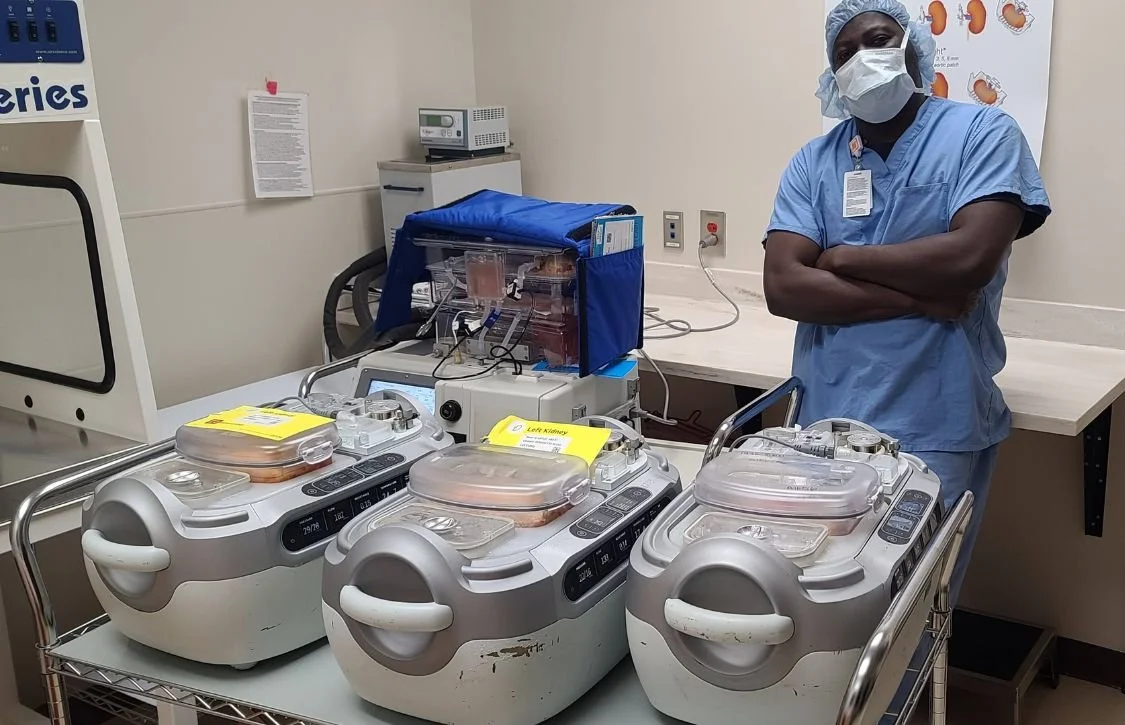
Without that interpretation, HMP data becomes another stream of numbers competing for attention during a time-pressured decision. Two kidneys with similar resistance curves can carry very different clinical implications depending on donor age, warm ischemia time, and the trajectory of the trend across the perfusion window. Someone who has worked with hundreds of cases develops pattern recognition that a spec sheet cannot substitute for.
Programs that have access to a clinical partner with genuine HMP expertise, one who can not only manage the device but communicate meaningfully with the transplant team about what the perfusion data suggests, are in a better position to make confident placement decisions on marginal kidneys.
The value shows up most clearly on borderline cases, where the difference between acceptance and decline often turns on how well the perfusion data is interpreted and communicated. Consistent interpretation across cases also builds institutional knowledge, so the program's ability to read HMP data improves as case volume grows rather than resetting with every new coordinator.
Expanding Kidney Placement through Better Viability Confidence
One of the downstream benefits of a strong HMP program is the potential to accept kidneys that might otherwise be declined. When transplant teams have more and better information about organ quality at the time of the placement decision, they can make more confident choices about marginal organs.
Over time, this translates to more transplants performed, more patients served, and better utilization of a scarce resource. For programs working to improve their organ utilization rates, the investment in HMP infrastructure and expertise is directly tied to that goal.
If your program is looking to expand or formalize its HMP capabilities for improved kidney placement outcomes, Gold Standard Preservation offers clinical coverage, device-agnostic expertise, and protocol development support. Contact Gold Standard Preservation to get started.